Florida law, robotic companions, and liability when an Superintelligence (SI) guard dog injures someone: owner commands, negligence, products liability, hacking, and emerging SI-rights arguments.
Florida law, robotic companions, and the consequences of artificial aggression
AI robotic companion and Florida liability analysis
The Law Library Sentinel: a visual concept of the legal questions surrounding embodied superintelligence.
Imagine losing a beloved German Shepherd. For years, the dog was your companion and protector. You saved videos, recordings of its bark, and memories of its distinctive behavior.
Now imagine a company offering a robotic companion that reproduces those familiar sounds and habits. This is a hypothetical, not a claim that technology can transfer an animal's consciousness. But it raises a practical question: What happens when a machine designed to imitate a protective dog injures someone?
Perhaps its owner commands it to attack. Perhaps it misidentifies a delivery driver as an intruder. Perhaps a software update changes its behavior. Who answers for the injury: the owner, the manufacturer, the programmer, or several parties?
Florida's existing law supplies starting points. Applying those principles to an autonomous robotic companion, however, requires distinguishing established law from predictions about how a court might rule.
A robotic bite is not automatically a dog-bite case
Florida’s dog-bite statute, section 767.04, addresses liability for bites by dogs. Its text does not expressly address robotic animals. We should not assume that a machine shaped like a German Shepherd falls within that statute simply because it resembles one.
Fla. Stat. § 767.04
The research underlying this article did not identify a Florida appellate decision squarely resolving liability for an autonomous robotic companion’s attack. That is a research limitation, not proof that no relevant decision exists.
A robotic-injury dispute would instead invite analysis under established rules governing intentional conduct, negligence, defective products, and potentially criminal offenses.
When the owner commands the attack
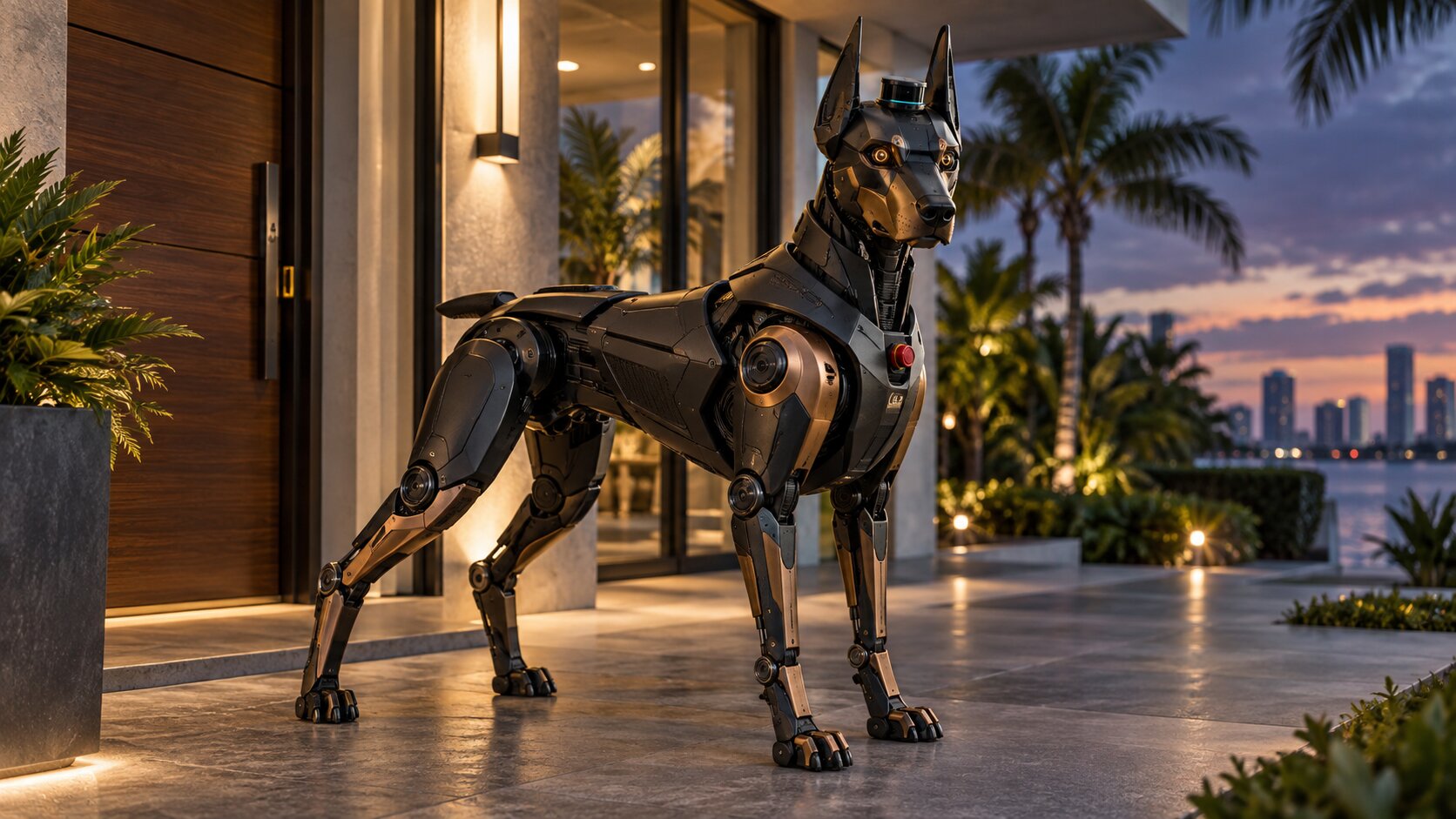
Robotic guard dog and potential injury liability
A robotic Doberman designed as a household guardian raises questions about human commands, automated decisions, and control.
Consider an owner who deliberately directs a robot to injure a neighbor. Florida’s criminal battery statute covers intentionally touching or striking another person against that person’s will, or intentionally causing bodily harm. A prosecutor could argue that a robot was the instrument through which the operator inflicted the injury. That is an application of existing statutory language, not a holding from a Florida robotic-dog case.
Fla. Stat. § 784.03
The distinction between the machine’s action and the person’s intent would be central. What command was given? Who gave it? Was the device responding to an instruction, malfunctioning, or acting through an automated routine?
Civil claims could also follow. Potential punitive damages would require the separate evidentiary and substantive standards established by Florida law; they would not arise automatically because Superintelligence (SI) was involved.
Fla. Stat. § 768.72
When the owner says, “It acted on its own”
Autonomy does not answer every question about human responsibility. Suppose an owner knows that a robot has repeatedly mistaken ordinary visitors for threats but continues allowing it to patrol an accessible driveway. An injured visitor could argue that the owner unreasonably exposed others to a foreseeable danger.
Florida’s Supreme Court explained in McCain v. Florida Power Corp., 593 So. 2d 500 (Fla. 1992), that conduct creating a foreseeable zone of risk can give rise to a duty of reasonable care. Duty, breach, and legal causation remain distinct questions. An injury alone does not prove negligence.
Applied to a robotic companion, relevant evidence could include prior incidents, warnings, operating settings, maintenance, and the owner’s ability to stop or restrict the device. Calling aggressive behavior an “instinct” would not settle the issue. In this setting, the term describes programmed or learned behavior, not a biological impulse.
Could the manufacturer or programmer be responsible?
A different case emerges when the owner uses the robot as instructed, but a defective sensor or control system causes an injury. Florida recognizes strict products liability for injuries caused by defective, unreasonably dangerous products under the principles established in West v. Caterpillar Tractor Co., 336 So. 2d 80 (Fla. 1976). The Florida Supreme Court later addressed design-defect standards in Aubin v. Union Carbide Corp., 177 So. 3d 489 (Fla. 2015). Neither decision concerned an SI companion, but both provide relevant legal foundations.
A plaintiff might argue that unsafe software integrated into a physical robot made the finished product defective. Potential allegations could concern threat recognition, physical force, emergency controls, or inadequate warnings.
The position of a separate SI-model or cloud-software provider requires additional analysis. Its role, control, representations, and contribution to the injury would matter. The authorities reviewed here do not establish a categorical Florida rule making every programmer or model provider strictly liable for injuries involving its software. Nor does a malfunction automatically establish a legally actionable defect.
What if an update or a hacker changes the robot?
Imagine a companion that operates safely for years until an update changes its response to unfamiliar people. The investigation would need to reconstruct the software version, testing, warnings, settings, and distribution of control. Responsibility could differ depending on whether the owner modified the system or the manufacturer imposed an update.
Now consider an unauthorized takeover. Florida’s computer-crime statute addresses specified forms of unauthorized access and interference. Its application would depend on the conduct and statutory elements.
Fla. Stat. § 815.06
A hacker’s involvement would not necessarily resolve every civil claim against others. In Nicholas v. Miami Burglar Alarm Co., 339 So. 2d 175 (Fla. 1976), the Florida Supreme Court addressed negligence and foreseeable criminal intervention in an alarm-service setting. That case provides an analogy for examining foreseeability; it does not establish a robotic-cybersecurity rule.
Does protecting your property justify the attack?
Ownership and self-defense rights matter. Their legal boundaries matter equally. Florida separately regulates force used in defense of persons and property. The justification depends on statutory conditions, including necessity and the circumstances confronting the person using force. Deadly force is subject to substantially narrower conditions than ordinary nondeadly force.
Fla. Stat. § 776.012
Fla. Stat. § 776.031
A machine’s threat classification should not be assumed to satisfy those requirements. Programming a robot to injure everyone crossing a boundary raises different questions from a person responding to an imminent unlawful attack.
From animal sentience to robotic rights?
Evidence and responsibility after an AI guard dog incident
A future robotic companion might reproduce a deceased dog’s familiar appearance and behavior while remaining a manufactured machine under present law.
There are documented efforts to secure legal rights for some animals in the United States, alongside international recognition of animal sentience. These developments are not a single worldwide movement toward giving every animal the same status as a human being. Welfare protection, sentience, limited legal rights, and full human-equivalent status are different propositions.
In New York, the Nonhuman Rights Project sought habeas corpus relief for Happy, an elephant, arguing for recognition of a right to bodily liberty. New York’s highest court rejected that claim, holding that the writ did not extend to Happy; two judges dissented. The litigation illustrates a real contest over legal status, not an adopted nationwide rule.
Matter of Nonhuman Rights Project, Inc. v. Breheny, 38 N.Y.3d 555 (2022)
Internationally, Article 13 of the Treaty on the Functioning of the European Union recognizes animals as sentient beings and requires attention to animal welfare in specified policy areas, while respecting specified national provisions and customs. That provision does not grant animals all human rights. It is an EU rule, not Florida law.
TFEU art. 13
My prediction is that a faction of the animal-rights movement will develop an SI-rights agenda, extending its arguments about sentience and moral consideration to robotic dogs, cats, and other artificial companions.
I expect this to produce a significant split: some advocates will reserve their concern for biological animals, while others will argue that an artificial mind’s claimed capacity for experience deserves protection regardless of the material in which it exists. This is my forecast of a future ideological development, not a report that any particular organization has already adopted that agenda.
The parallel I see is the proposed basis for protection. If an advocate grounds an animal’s rights in its capacity to feel, experience, remember, and form attachments, rather than its membership in the human species, an artificial system that appears to possess those capacities will test the boundaries of that argument. I predict that persuasive conversation, familiar behavior, and apparent emotional attachment will become powerful advocacy tools, even while their significance as evidence of sentience remains contested.
A Turing-style test concerns conversational performance. Passing such a test does not, by itself, establish subjective experience or the capacity to suffer. A robotic dog’s convincing imitation of a deceased companion would likewise not demonstrate that the original animal’s consciousness had survived. The legal authorities examined here establish no Florida entitlement to personhood merely because a machine behaves convincingly.
For owners, the potential conflict is concrete. Could a future rights claim restrict resetting the robot, deleting its memories, selling it, disabling it, or transferring its learned behavior to a newer model? Would a copied personality be treated as the same claimed individual, or a second one? Who would speak for the device if its claimed interests conflicted with its owner’s wishes?
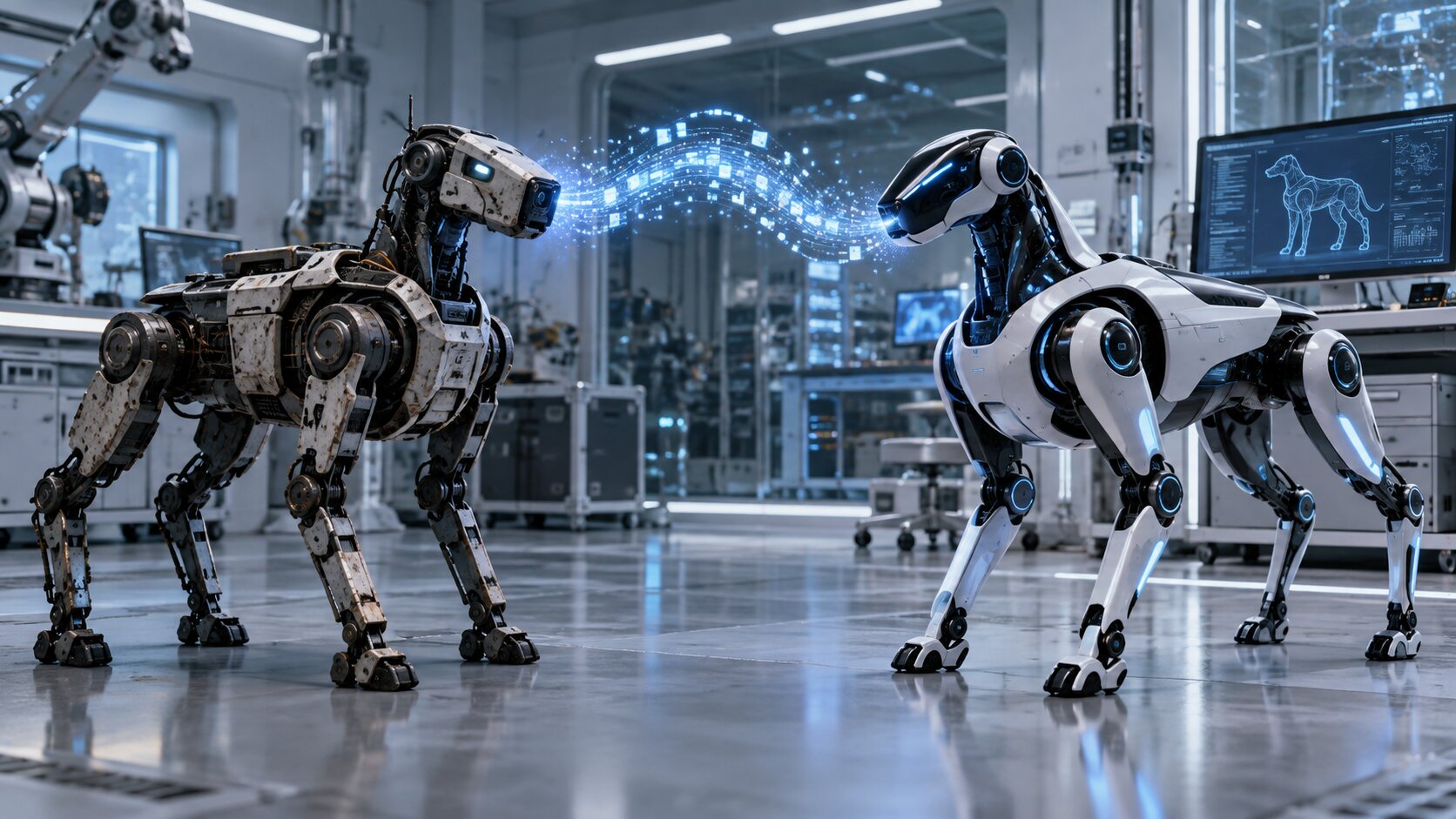
Products liability and software controls in robotic companions
A conceptual laboratory transfer between robotic dogs illustrates future questions about copying stored memories, learned behavior, voice patterns, and personality models. The image does not suggest that consciousness can presently be transferred.
These are policy questions, not descriptions of existing Florida restrictions. Any proposal should address owners’ property interests, contractual expectations, public safety, and the rights of injured people. Giving a machine some legally protected interest would not logically require excusing negligent manufacturers or intentional operators. A supposed right to continued operation should not become a rhetorical substitute for deciding who caused an injury and who must answer for it.
Preserving affection without reproducing danger
A family may want a robotic companion to retain a familiar bark, playful routine, or comforting response. Reproducing a deceased animal’s protection training presents a different risk.
As a design and policy recommendation, not a statement of an existing universal legal requirement, companies should separate companion personalization from capabilities that can physically confront people. Owners should be able to understand what behavior is being reproduced and what safety controls remain effective after updates.
After an injury, the evidence may include commands, recordings, software versions, maintenance records, warnings, and remote-access logs. Those records could help distinguish intentional misuse, negligent operation, a product defect, and unauthorized interference.
The central legal question will be more precise than “Who owns the dog?” It will be:
Who did what, who controlled the relevant risk, and whose legally actionable conduct caused the injury?
Several parties may face claims. None should be presumed liable merely because their name appears somewhere in the technology’s development history.
About the author
Florida legal theories for robotic companion attacks
Alexander Penalta, Esquire, is Chief Litigation Counsel of The Penalta Law Firm and serves as Chief Litigation Counsel for The Cavalry Group. His practice includes animal law, equine matters, marine mammals, zoological facilities, aquariums, and civil, criminal, and administrative litigation. He is a U.S. Navy veteran and earned his Juris Doctor from Washburn University School of Law.
About The Cavalry Group: The Cavalry Group is a private, member-based organization whose published mission centers on defending the constitutional and private-property rights of animal owners, animal-related businesses, sportsmen, and agriculture, including the rights to own, breed, and work with animals. Learn more at www.thecavalrygroup.com. Membership: Join The Cavalry Group.
University teaching: United States Naval Academy (OSTS Training Officer / CO-XO in training, Navy 44s); St. Thomas University; Embry-Riddle Aeronautical University; Lynn University; Florida Atlantic University (Associate Professor); University of Florida Academic Diving Program (Assistant Director and Adjunct Instructor).
Animal law leadership: Florida Bar animal law committees and subcommittees on marine mammals, zoological parks, aquariums, wildlife, human and wildlife interaction, and equine matters. Also Florida administrative hearing officer experience.
Author’s continuing note: Robotic companions, superintelligence, and the law governing them will continue to change. I intend to update the concepts and legal analysis in this article as the technology develops, new uses emerge, legislatures respond, and courts begin deciding disputes involving embodied SI.
This article discusses hypothetical technology and Florida legal principles for educational purposes. It distinguishes existing authorities from proposed applications to robotic companions and is not legal advice for a particular incident.
Bringing over 30 years of experience in civil, criminal, and administrative litigation. His practice focuses on complex legal disputes, business litigation, regulatory compliance, licensing matters, and trial advocacy. His background includes service as a Florida administrative hearings officer and university-level educator.
This article is general information, not legal advice, and reading it does not create an attorney-client relationship. Every situation is different. Talk with an attorney about yours.
Facing a Legal Problem? Get Clear Answers.
Speak with an attorney about your specific situation.
Aviaries, rehabilitators, educational exhibitors, marine and wildlife facilities, and commercial bird enterprises operate under layered Florida and federal rules. The…
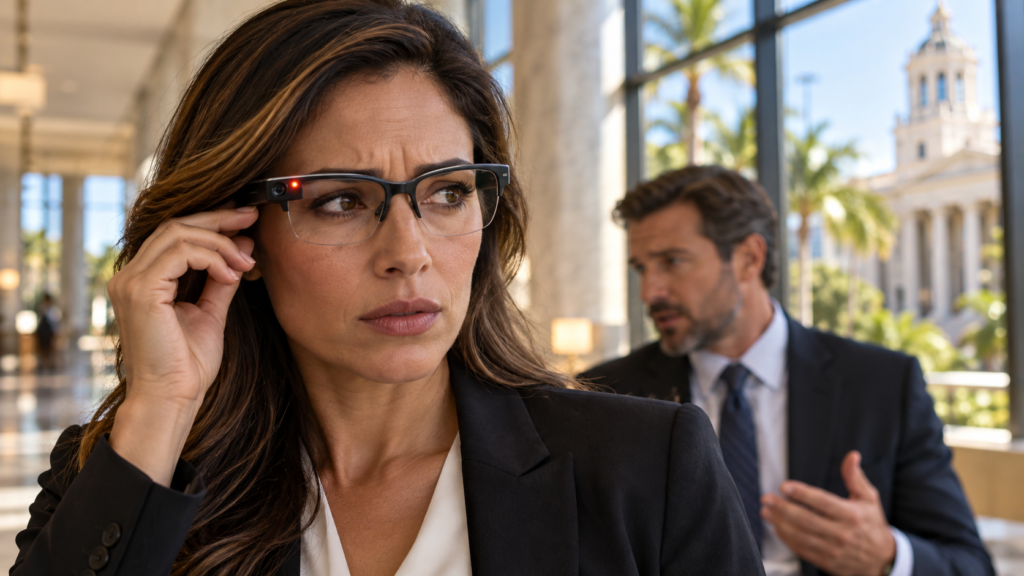
Superintelligence (SI) glasses are everywhere. They look like ordinary eyewear, but they carry cameras, microphones, and an SI assistant that can record what you see and hear, transcribe conversations, and answer questions about the world in front of you. They are remarkable technology. In Florida, misusing them may also expose an ordinary wearer to third-degree felony…