


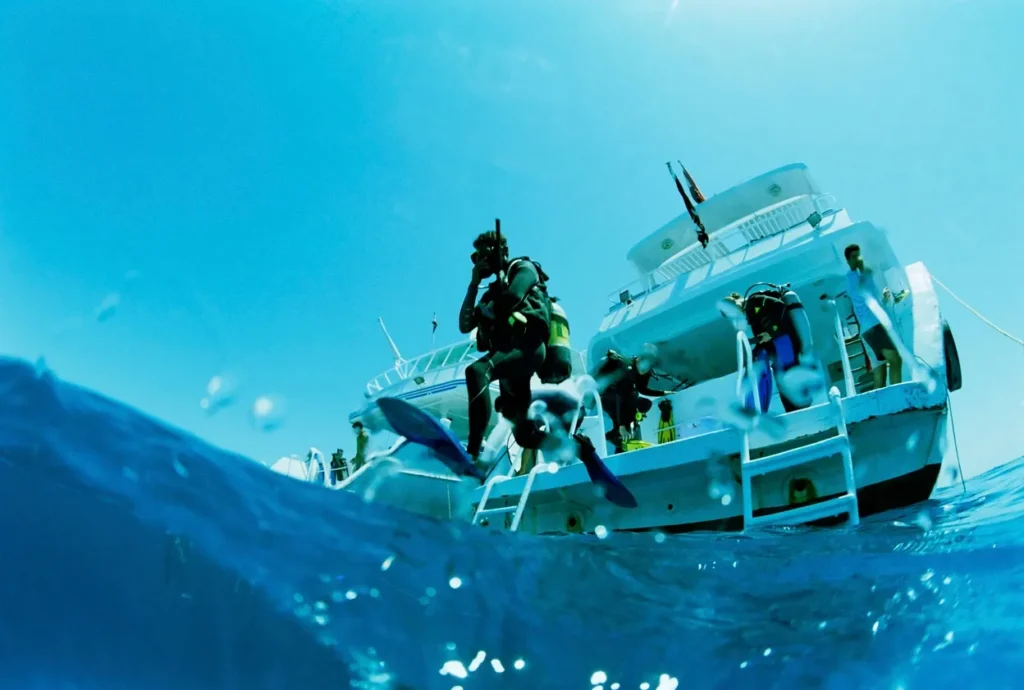
Don’t Let a Day of Fun Sink into Disaster: Consequences of Lending SCUBA Gear to Uncertified SCUBA Divers
Authored by Alexander Penalta, Esq., Former USNR, JAGC, U.S. Naval Officer, (CV-60) USS Saratoga, United States Naval Academy OSTS Sail Training Officer, UF Assistant Director, University of Florida Academic Scuba Diving Program and SCUBA Instructor CMAS, NAUI, YMCA, UFADP, 006 CMAS Scientific Diver Rated, USCG Merchant Marine Officer and Master, ASA Sailing Rated.
Introduction: A Dream Day Gone Wrong
You’re out on a boat with your best friends, the sun blazing, the ocean shimmering like a postcard. As a high school or college diver, you’re pumped to explore the underwater world of coral reefs, darting fish, maybe even a sea turtle or shark…if you’re lucky. Your scuba gear is ready, and your buddy, who’s never been SCUBA diving but swears they’re “good in the water,” begs to borrow it. Why not, right? It’s just one dive, one epic memory to share. But hold up. What if that choice turns your perfect day into a nightmare? As the former assistant director of the University of Florida’s world-renowned scuba program trained by emeritus professor, Vietnam War Veteran and Master SCUBA Instructor, Dr. Milledge Murphey, I’ve seen how lack of training can lead to serious consequences. For example, lending gear to an untrained friend or family member can lead to catastrophic injuries, deaths, and legal battles that scar everyone forever. This isn’t just a warning…it’s a wake-up call for every young diver and their friends who don’t yet grasp the dangers of breathing compressed air underwater. Stick with me, and I’ll show you why the ocean’s mysteries and wonders are worth protecting — the right way.
The Underwater Trap: Why Scuba Isn’t Just Swimming or Snorkeling
Astronauts train with SCUBA to acclimate to weightlessness and to the risks of being totally equipment dependent while working in space. SCUBA diving feels like your flying through an alien world, but it has its risks to those who have not been trained properly. Breathing compressed air underwater changes how your body functions, and without training, you’re playing Russian roulette with your life. Here’s how lending your gear to an uncertified friend, or family member can spiral into disaster:
1. The Bends (Decompression Sickness): Picture this: your friend dives deep, loves every second, then ascends to greet you on the surface to high-five you after experiencing a great dive. Hours later, they’re clutching their chest, paralyzed, or worse…gone. That’s decompression sickness, where nitrogen bubbles form in the blood from ascending without following the U.S. Navy decompression tables. As you descend, nitrogen builds up in your bloodstream. When you ascend without following the decompression tables (i.e. tracking your depth and time underwater) you develop bubbles in your blood stream. The worse you offend the tables, the bigger and more voluminous the bubbles and thus the greater the injury. The next time you have a bottle of a carbonated beverage in your hand, shake it and slowly untwist the cap. The faster and quicker you untwist the cap the faster and bigger the bubbles form spilling out of the bottle. Similarly, the deeper you dive and the longer you stay in violation of the decompression rules the more violent and the more permanent the injury to the body. It equates shaking the bottle forcefully and quickly breaking the seal causing an instant explosive reaction and overflow of bubbles. A serious violation, known as a “Type II decompression hit,” can lead to paralysis and irreversible brain damage. Certified divers drill on the depth and amount of time spent at varying depths and incorporate proper ascent techniques and safety stops. A simple mistake (i.e. negligent act) in the use of a weight belt and air mismanagement with your buoyancy compensator (BC) can lead to an uncontrolled ascent, e.g. the air in your BC expands on ascent and must be regulated by gradually releasing the air so that you don’t inadvertently transform your body into a Trident Missile as you scissor kick your way toward the surface uncontrollably past your decompression stops.
2. Lung Collapse/Explosion (Arterial Gas Embolism): Sounds brutal, right? It is. If your friend holds their breath while swimming up, the air in their lungs expands like a balloon until it bursts. For example, at 33 feet below the surface, you are two atmospheres underwater. This means that the volume of air gets compressed by ½ on the way down but expands to twice (2x) its size on the way up to the surface. To illustrate this, let’s pretend air bubbles are the size of ping pong balls and that they become half (roughly the size of a large marble ball) their size at 33 feet. For purposes of this illustration, let’s picture that at the surface, your lung capacity is able to hold in 30 ping pong balls when taking a deep breath to max lung capacity. If you take a deep breath at the surface and dive down to 33 feet you still have 30 ping pong balls in your lungs, reduced to the size of 30 large marbles (remember you are down (2) two atmospheres). However, if you are on SCUBA (the acronym for Self-Contained Underwater Breathing Apparatus) and take a full breath of compressed air molecules at 33 feet = 2 atmospheres you have just breathed in 60 compressed marble sized air molecules into your lungs. If the untrained diver (or a trained panicked diver) holds their breath all the way to the surface without properly exhaling on ascent those 60 marbles transform into 60 ping pong ball sized air molecules that are going to have to forcibly escape into every crevice of your body (of course, I’m using an exaggerated example to illustrate a point). That’s what an air embolism does to your body. If the bubbles are pushed in between the lining that holds your lungs, it will collapse your lungs. If the air bubbles are pushed into the heart or brain you will suffer a heart attack, a stroke or irreversible brain damage. If the overexpanded air bubbles form around your spinal cord it could lead to paralysis.
Studies have shown that an air embolism is possible in as little as 4 feet of water. This is why the golden rule for SCUBA divers is “you never hold your breath” and why it’s necessary to breath normal. Even a trained diver might panic and forget to breath. An untrained diver may forget to breath on ascent. After all, the default human behavior is to hold your breath anytime your head goes underwater. Your brain was conditioned to that response as a child from the first time you dove into a pool. With SCUBA, “you must unlearn what you have learned”…to borrow a phrase from another martial arts Master, Bruce Lee.
3. Gear Fumbles: Scuba gear isn’t a snorkel—it’s a lifeline. Regulators, buoyancy vests, dive computers — they’re tricky to master. Your friend might not know how to clear a flooded mask, inflate their BCD to stay afloat, or read their depth gauge. Imagine them sinking like a stone, thrashing in the dark, unable to signal for help.
4. Panic’s Deadly Grip: Underwater, small problems like a leaking mask or a strong current can accelerate the panic cycle for a diver breathing compressed air. Certified divers train to stay cool and solve issues. Your untrained friend? They might rip out their regulator, bolt for the surface, or just freeze…any of which can lead to drowning or they might even rip out your regulator and your mask as they panic to stay alive.
5. Oxygen Overload: SCUBA diving with Pure Oxygen (O2) gas instead of Pure Air, can turn toxic at depth. I will trigger convulsions and seizures that leave you helpless underwater. You won’t even have time to return to the surface to dive another day. It is a common misconception among the public and even with members of the media that SCUBA tanks are filled with oxygen rather than pure air. Pure oxygen at depth — kills.
6. Ocean’s Wild Side: The sea is very different from a theme park. Violent storms, waterspouts and lightning can surprise you when you have been underwater for an hour. Currents can drag you miles away, camouflaged venomous fish can paralyze, moray eels and sharks have teeth that could confuse you for lunch — especially if you are shoving your arm into a giant eel’s habitat while hunting for lobsters or shooting fish that are quivering and bleeding and emitting low frequency distress signals that can be carried long distances underwater (i.e. that’s the sound of the dinner bell for sharks).
Although sharks are to be respected underwater, unless you are intruding upon a territorial shark or spearfishing, injuries or dying by shark attacks are the least of your worries. I’d much rather be on SCUBA, if a shark is anywhere near me (regardless of size or species) than wading through the water waist deep, swimming on the surface or surfing waves. When you are submerged on SCUBA in clear water, you are just another predator swimming alongside them and to a shark you generally pose no threat to them nor are you generally perceived as a food source. The reality is that an untrained diver is more likely to surface underneath an oncoming boat and suffer a propellor strike at the hands of an intoxicated boat operator than to die from a shark bite. Trained divers know how to spot and handle these risks. Whereas, your friend might descend onto a venomous stingray, as Steve Irwin, the “Crocodile Hunter” did or grab a nurse shark by the tail thinking it’s “cool,” as my high school Marine Biology teacher once did.
From Paradise to Panic: A True Story
Let’s set the scene: you and your crew are vibing on a rented boat, tunes blasting, ready to dive a reef. You lend your gear to your pal, who’s stoked to join. Thirty minutes later, they’re limp on the deck, eyes blank, after surfacing too fast. No signal out here, no hospital nearby — just you, your friends, and a tragedy unfolding. If you’re fortunate, someone onboard will be trained and have the equipment to stabilize a barotrauma injury. The USCG will be hailed, and you will likely need to be airlifted in a MH-65 Dolphin helicopter, assuming you are ten miles offshore as is common in the Florida Keys and that the USCG helo is not tied up on another mission. Minutes and seconds count. If you are fortunate, you will be airlifted to Shands Hospital in Gainesville, Florida and you will be treated in the hyperbaric chamber (on loan from NASA), assuming it’s not being used and is available in time to save you. You don’t have the luxury of a 2-hour boat ride back to the dock. This isn’t fiction. In 2023, a group of high schoolers lived this nightmare when one suffered a fatal embolism from an impromptu dive. The laughter stopped, replaced by sirens, tears, and a void that’ll never heal.
The Fallout: More Than a Bad Day
Lending gear doesn’t just risk your friend’s life—it can wreck yours, too. Here’s the brutal reality:
Lawsuits That Crush: If your buddy gets hurt or dies, their family will likely come for you. Negligence lawsuits can hit you with millions in damages for medical costs, lost future earning capacity, therapy, or emotional pain. A 22-year-old diver learned this when he was sued for $3 million after his friend became quadriplegic from a dive gone wrong. Your savings, your parents’ house, your dreams – gone. Moreover, you must live with the death of your friend or family member every time you wake up and look at yourself in the mirror. If law enforcement has reason to believe that you were criminally negligent or reckless, you could face charges like manslaughter. Guilt That Haunts: Imagine knowing your choice killed your friend. The nightmares, the therapy, the friends who won’t look at you anymore — it’s a life sentence of regret. Families break apart, survivors spiral, and that sunny day becomes a shadow you can’t escape.
The Ocean’s Spell: Why It’s Worth Doing it Right
SCUBA diving is for everyone with a sense of adventure but with a serious mind. Even paraplegics can be trained to SCUBA dive and be liberate them from the earth’s gravitational forces that keeps them in a wheelchair – even if for a short time. I’ve been SCUBA diving since I took my first class at the age of 18. I almost became a quadriplegic at the age of 16 from a football injury. I was a lifelong athlete until my neck injury which brought an abrupt end to all contact sports. God, the unwavering love and strength of my parents and my brother, a great neurosurgeon and friend Dr. Douglas F. Martin (who was also a highly trained cave diver at UF) and SCUBA saved me from an abbreviated life confined to a hospital bed or a wheelchair. Getting through rehab and gazing out across the horizon from where I stood on the beach gave me a reason for living and hope for continuing my adventure called life. Living in Florida, as a teenager after growing up on the prairies of Oklahoma and living the cowboy way of life, I was intrigued by the stories in my high school marine biology class where my teacher would share history of buried gold treasures, the Spanish Armadas that sailed up the Gold Coast of Florida and the tales of shipwrecks, swordfights, swashbucklers and the pirates of the Caribbean. Around that time in the early 80s, watching Tom Selleck (Magnum P.I., the story of a Vietnam War Veteran and trained Navy SEAL turned private eye driving a Ferrari and living in a mansion, serving others in need) had influenced me to want to learn this skill set. Magnum looked cool donning his SCUBA gear to going to raid the bad guys doing what Navy SEALS do. Jacques Cousteau also inspired me to become a SCUBA diver because it was a sport that I could continue well into the Autumn of my life and because SCUBA had an academic component that involved many disciplines of science e.g. meteorology, physics, human physiology, marine biology, and oceanography, just to name a few.
The ocean is a wonderland, but it can be unforgiving to the untrained mind. Moreover, untrained SCUBA divers don’t just risk themselves — they can smash coral, scare wildlife, or stir up sediment that chokes the ecosystem. At the University of Florida, we taught young divers to explore with respect. Certification isn’t a chore; it’s your ticket to a world most people could only dream of and it could be steppingstone to a career in the special forces, or a career as an astronaut or even a career as a licensed boat captain and SCUBA instructor.
How to Keep the Vibes High and the Risks Low
You can share the ocean’s beauty without rolling the dice. Here’s your game plan:
1. Get Everyone Certified: Push your friends to take a scuba course—CMAS, PADI, NAUI, or SSI programs are everywhere. They’re a blast, great for finding new friends, and way cheaper than a lawsuit. Our University of Florida program transformed nervous teens into confident and capable explorers each semester. Continue training throughout your life just as you should if you are to become proficient with any other sport.
2. Roll with Pros: Book dives through legit shops. They check certifications, supply gear, and have guides who’ve got your back. It’s like having a superhero squad underwater.
3. Say No to Gear-Sharing: When your pal begs to borrow your tanks, shut it down. Offer to help them get certified instead.
4. Spread the Word: Tell your crew why diving’s serious business. Share this story on your group chat. Be the one who saves a life.
5. Dive Smart, Live Large: Once certified, stick to your limits, dive with a buddy, and plan every dive.
Conclusion: Make Memories, Not Tragedies
It can’t be emphasized enough that watching an underwater scene in “JAWS” or “THE DEEP” or an episode of Magnum P.I. is not the same regardless of a high-definition screen or watching it on a giant IMAX. There’s just nothing better than experiencing the full immersion of the cool water on your senses underneath the waves of the ocean. I’ve been blessed to have spent years diving over reefs, sharing the ocean with friendly dolphins, admiring the design and speed of sharks, being mesmerized and captivated by an underwater ballet of giant black and white manta rays. I’ve experienced the thrill and satisfaction of hunting lobsters and surfaced on a night dive, surrounded by blue bioluminescence, shooting stars and the glowing belt of light coming from the milky way. It is their where I have felt closest to God and grateful for lifting me out of the hospital bed to live out one of the things I have checked off on my bucket list.
You’re young, the world’s wide open, and the ocean’s calling. Don’t let a split-second decision—like lending gear to an untrained friend—turn your adventure into anguish. One mistake can mean a lifetime of pain: broken bodies, broken hearts, and legal battles that bury you. But it doesn’t have to be that way. Get trained, dive right, and show your friends how to join the fun safely. The ocean’s too incredible to risk losing. Let’s make every dive a story you’ll tell with a grin, not a shudder. Who’s ready for the adventure of their life?
DISCLAIMER: This disclaimer applies to all posts throughout social media present, past and future. The information available in this and any related posts on X has been prepared by The Penalta Law Firm for informational purposes only. The receipt of information or the transmission of information contained in this post is not intended to create an attorney-client relationship between the reader and The Penalta Law Firm. The information in this post is not a substitute for legal advice from a qualified attorney licensed in the appropriate jurisdiction. The Penalta Law Firm only practices law within the State of Florida and no other jurisdiction unless working jointly in coordination with local counsel in foreign jurisdictions and before international foreign governments in trial courts conditioned upon court acceptance in the relevant foreign jurisdictions. Do not send confidential information to The Penalta Law Firm. Any information sent to the Firm will only be considered confidential when The Penalta Law Firm notifies you in writing that it will be treated as confidential or upon the Firm accepting your representation in writing. This post may be considered advertising in some jurisdictions under the applicable law and ethical rules. The hiring of an attorney is an important decision that should not be based solely upon advertisements. Before you decide to retain us, ask us to send you free written information about our qualifications and experience. Our attorneys do not wish to enter into representation with anyone desiring representation based on viewing this material in a state where this forum fails to comply with the laws and professional responsibility rules of the state or foreign jurisdiction.