The Space Coast’s Second Golden Age: How Blue Origin, NASA, SpaceX, and the Department of War Are Launching America’s Off-World Economy
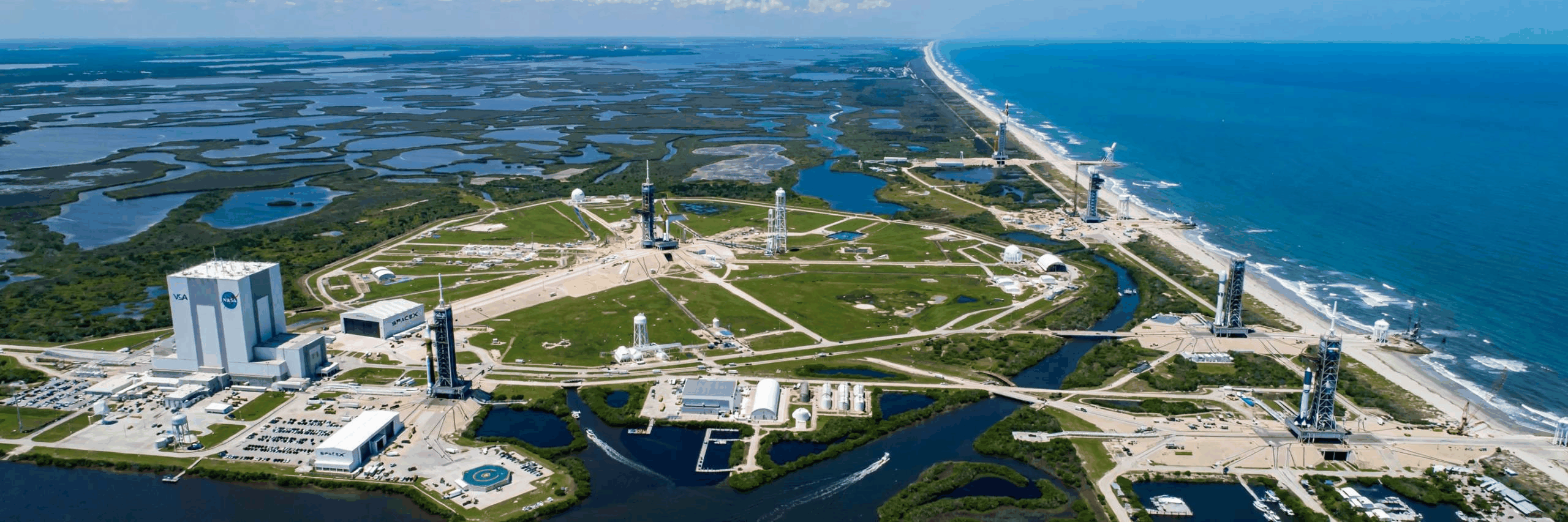
There is a moment, standing on the river at dawn while a rocket climbs out of Cape Canaveral and the whole eastern sky catches fire, when you understand what the Space Coast really is. It is not only a place. It is a promise: that the hardest things human beings attempt will be attempted here first. We are living through the second golden age of that promise, and it will be larger, in every dimension, than the first.
Blue Origin Has Come Home to the Space Coast
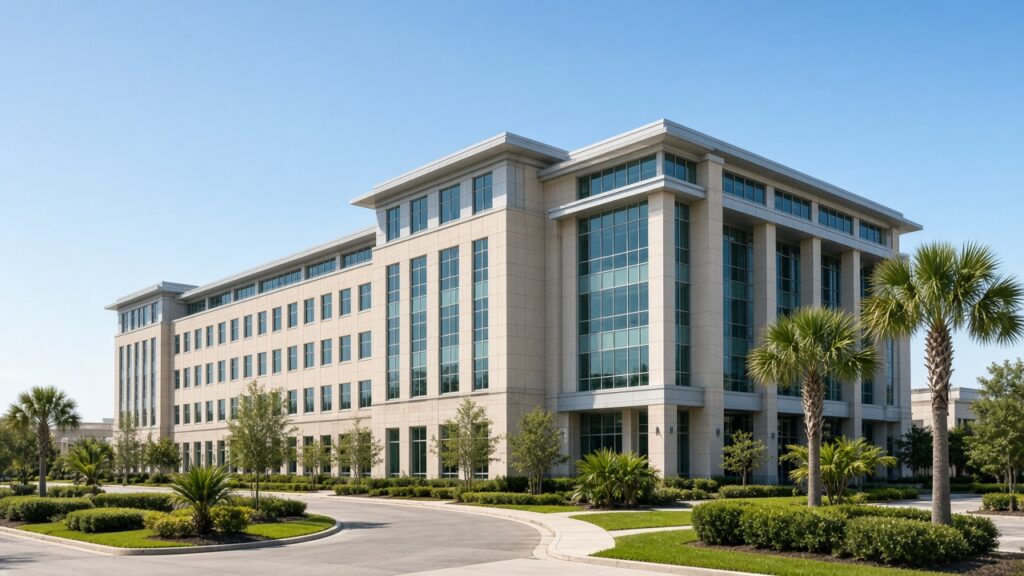
Blue Origin’s growing presence at Cape Canaveral, with New Glenn heavy-lift operations, advanced manufacturing, and the company’s lunar ambitions through the Blue Moon program, represents a substantial private investment in Florida’s Space Coast. These are not symbolic footprints. They are factories, launch complexes, test stands, and mission control rooms, each one staffed by engineers, technicians, machinists, and mission planners earning the kind of wages that transform families and communities. Blue Origin reports substantial Florida employment and spending with Florida suppliers in support of its New Glenn program.
A New Model: Cooperation Among Giants
What makes this era different from Apollo is the architecture of cooperation behind it. NASA sets the destination with the Artemis program and the return to the Moon. The Department of War secures the high ground on which national security depends. SpaceX has proven that rapid, reusable flight can be done at a cadence once thought impossible. And Blue Origin brings heavy lift, lunar landers, and orbital infrastructure built for the long term. These institutions compete fiercely and cooperate necessarily, with the government as anchor customer and the commercial sector as the engine of innovation. Competition can reduce launch costs. Partnership drives up ambition. The result is a launch market, and commercial partnerships that may expand what any single government could build alone.
An Economic Engine for Brevard and Beyond
The economic consequences are already visible and could extend well beyond today’s launch activity. Direct employment in engineering, manufacturing, and launch operations is only the beginning. Around every launch provider grows an ecosystem: suppliers, machine shops, software firms, logistics companies, and service businesses, many of them small Florida enterprises partnering directly with the government and the space community. Workforce pipelines run through Embry-Riddle Aeronautical University, the University of Central Florida, Florida Tech, and Eastern Florida State College, turning Space Coast students into Space Coast engineers. Launch weeks bring visitors to local hotels and restaurants, and the world’s attention to what everyone here already knows: the future has a mailing address, and it is on the Space Coast.
The Moon, and Everything After
This is not only a return to the Moon, though that alone would be historic. It is an effort aimed at developing a sustained cislunar economy: landers, gateways, surface habitats, resource utilization, and the satellite constellations that will connect every corner of the planet. Some missions could support the infrastructure for those that follow. The Moon is the proving ground. Mars is the horizon. And the technologies proven along the way, in propulsion, life support, autonomy, and manufacturing, will flow back into the terrestrial economy in ways we are only beginning to imagine.
Superintelligence Could Expand What Space-Coast Teams Can Build
There is one more potential force multiplier: superintelligence (SI). If superintelligent systems are developed and shown to be reliable, they might one day assist with engineering design, manufacturing, and mission planning, subject to human oversight, testing, safety requirements, and regulatory constraints. The children growing up on the Space Coast today will not merely watch rockets. They may one day design them with such tools more powerful than any previous generation had, and the opportunities before them could be extraordinary.

The Space Force and the Private Launch Industry: Intertwined by Design
None of this happens without the other great creation of this era: the United States Space Force. The rise of the private launch industry and the rise of the Space Force are not parallel stories. They are the same story, told from two directions. Assured access to space is a national security imperative, and commercial providers can build, iterate, and fly rockets at a pace that strengthens the nation’s launch industrial base, although national-security readiness depends on mission-specific vehicles, facilities, contracts, and approvals. So the Department of War made commercial industry a strategic partner as well as a vendor: the Space Force relies in part on commercial launch providers while supplying mission requirements and range support. Companies such as SpaceX, Blue Origin, and United Launch Alliance bring different launch vehicles and commercial capabilities; some are advancing reusable architectures. The Space Force brings mission requirements, range infrastructure, launch assurance, and the warfighter’s perspective on what orbit must deliver. Each makes the other stronger. Commercial launch operations and Space Force range operations coexist on the Space Coast, and commercial launch activity sustains the workforce and infrastructure that underpin the nation’s launch capacity. Industry and the Space Force are intertwined and complementary by design, and the Space Coast is where that partnership touches the sky.
Why Satellite Replacement Could Sustain Launch Demand
A fair question from the public is: why do we need to launch so often? Part of the answer lies in constellation replenishment. SpaceX describes Starlink satellites as having an approximately five-year design life and says operational satellites can be propulsively deorbited at the end of service. Starlink satellites are periodically deorbited, and larger constellations could increase replacement demand. Maintaining a constellation at a chosen capacity can create recurring replacement demand, although its duration and scale depend on future decisions. The launch business is therefore not only a series of one-time events. Like infrastructure, it can require sustained activity over time.
The projected numbers are ambitious, and they come from the leaders themselves. In an August 2026 post reported by Teslarati, Musk described an ambition of 30-plus Starship launches per day in 2030, about 10,000 annualized, not an approved schedule. The August 2026 National Space Transportation Policy states that U.S. space transportation ranges must grow to support more than 1,000 launches and reentries each year by 2030. Blue Origin has requested FAA review of a license modification that would raise its permitted New Glenn launch maximum at Cape Canaveral from 12 to 50 per year; the proposal remains under review. In July 2026, Space Systems Command announced two SpaceX task orders totaling $1.6 billion for 18 Falcon 9 launches supporting its space-based sensing and targeting portfolio; the launches are expected from Vandenberg by the end of 2027. Launch demand keeps rising as operators replace aging spacecraft, deploy new systems, and support national security missions.
Hegseth addressed Blue Origin employees during a February 2026 Arsenal of Freedom tour stop identified in the official event record as Cape Canaveral and emphasized the importance of space to national security. His remarks underscore the administration’s emphasis on expanding the capacity to produce and deploy space systems.
That industrial base spans the nation, which is why this matters far beyond Brevard County. Florida is one launch center; Texas and California also host launch operations, while facilities in Alabama and Louisiana contribute to rocket and deep-space manufacturing. Their work merits public attention because launch and space systems can contribute to national security and economic activity.
And the returns have often come back to Earth. NASA documents terrestrial applications of space research, including weather information, water-treatment technologies, and medical technologies. We go to space to solve the hardest problems, and the solutions often come home. What is being built on the Space Coast today, in Florida and Texas and Alabama and Louisiana and California, follows the same arc. It supports the nation and employs its people, and future projects may yield further benefits, though their returns cannot be guaranteed. Higher launch and reentry rates also call for continuing safety and environmental assessment.
For the Children Watching the Sky
There is another mission riding on every one of those rockets, and it may be the most important of all: inspiration. On the Space Coast, a child does not have to imagine a launch. She can stand in her own backyard, feel the rumble move through her chest before the sound even arrives, and watch a pillar of fire climb into a blue Florida sky. No screen, no simulation, no description in a textbook can do what that moment does. It plants a question that never quite leaves: what if that were me?
We have seen this before. Apollo inspired many people to pursue science and space careers; today’s launches may do the same for another generation. For some future guardians, pilots, and astronauts, that path may begin by looking up. And many of them may come back: as teachers, as founders, as leaders, contributing to a better society with everything the journey taught them.
That is why the educational stakes are so high, and why every school near a launch site, and far from one, should treat these missions as curriculum. A rocket on the pad gives a student a reason to care about the mathematics of thrust, the physics of orbital mechanics, the chemistry of propulsion. Human spaceflight reaches further still: into biology, anatomy, and physiology, the study of how the human body endures and adapts beyond Earth; into astronomy, medicine, materials science, and robotics. A launch can connect lessons across many scientific disciplines. It is much bigger than launching rockets. It is an invitation into all of human knowledge, issued in fire and thunder.
Giving students a tangible goal can encourage them to undertake the work of learning how to build it. That is how a coastline that launches rockets also launches scientists, physicians, engineers, and explorers. The second golden age will not only be measured in tonnage to orbit. It will be measured in the students who watched the sky catch fire and decided to spend their lives reaching it.
Space: The Final Frontier
Fifty years from now, historians will mark this decade the way we mark the 1960s: as the moment a coastline in Florida became the departure lounge for the rest of the solar system. Blue Origin, NASA, SpaceX, and the Department of War, working in the cooperation and competition that has always driven American greatness, are writing that history now. Future generations may find routine work in orbit, and our economy may stretch to the Moon. And it will have started here, where the rockets rise over the Atlantic and the whole sky catches fire. The second golden age of the Space Coast is not coming. It is here.
About the Author

Alexander Penalta, Juris Doctor, is a former Florida Department of Labor administrative hearing officer, a U.S. Navy Reserve Lieutenant Junior Grade (1990-1992) in the Judge Advocate General’s Corps, and a former Associate Professor at Embry-Riddle Aeronautical University (1997 to 2007), where he taught aviation law, business law, and graduate-level courses. His students included rocket propulsion engineers who worked for NASA, the Department of Defense (now also referred to as the Department of War), and Sikorsky, as well as students in specialized defense programs. He has also taught graduate and undergraduate courses at Lynn University and Florida Atlantic University. He holds an FAA private pilot certificate and flies regularly with certified flight instructors in a variety of aircraft. An AOPA Legal Services Plan attorney since 1994, he is the founder of The Penalta Law Firm in Edgewater, Florida, where he has practiced for more than 30 years in employment, aviation, business, and national security law. He is bilingual in English and Spanish.
Related legal resources: Explore the firm’s aviation and drone law practice. For primary-source research, see the NASA’s Kennedy Space Center overview. NASA maintains current information on its Florida launch facilities.