

Open Letter to Elon Musk: Technological Potential for Developing an AI Language Model for Communicating with Animals
By Alexander Penalta, Esq.
Possibility of AI-Mediated Communication
Optimus and Animal Interaction
Exploring AI’s Role in Human-Animal Communication
Genesis 3:.
1 Now, the snake was the most subtle of all the wild animals that Yahweh God had made. It asked the woman, ‘Did God really say you were not to eat from any of the trees in the garden?’
2 The woman answered the snake, ‘We may eat the fruit of the trees in the garden.
3 But of the fruit of the tree in the middle of the garden God said, “You must not eat it, nor touch it, under pain of death.” ‘
4 Then the snake said to the woman, ‘No! You will not die!
5 God knows in fact that the day you eat it your eyes will be opened and you will be like gods, knowing good from evil.’
6 The woman saw that the tree was good to eat and pleasing to the eye, and that it was enticing for the wisdom that it could give. So she took some of its fruit and ate it. She also gave some to her husband who was with her, and he ate it.
7 Then the eyes of both of them were opened and they realised that they were naked. So they sewed fig-leaves together to make themselves loin-cloths.
8 The man and his wife heard the sound of Yahweh God walking in the garden in the cool of the day, and they hid from Yahweh God among the trees of the garden.
9 But Yahweh God called to the man. ‘Where are you?’ he asked.
10 ‘I heard the sound of you in the garden,’ he replied. ‘I was afraid because I was naked, so I hid.’
11 ‘Who told you that you were naked?’ he asked. ‘Have you been eating from the tree I forbade you to eat?’
12 The man replied, ‘It was the woman you put with me; she gave me some fruit from the tree, and I ate it.’
13 Then Yahweh God said to the woman, ‘Why did you do that?’ The woman replied, ‘The snake tempted me and I ate.’
14 Then Yahweh God said to the snake, ‘Because you have done this, Accursed be you of all animals wild and tame! On your belly you will go and on dust you will feed as long as you live.
15 I shall put enmity between you and the woman, and between your offspring and hers; it will bruise your head and you will strike its heel.’
16 To the woman he said: I shall give you intense pain in childbearing, you will give birth to your children in pain. Your yearning will be for your husband, and he will dominate you.
17 To the man he said, ‘Because you listened to the voice of your wife and ate from the tree of which I had forbidden you to eat, Accursed be the soil because of you! Painfully will you get your food from it as long as you live.
18 It will yield you brambles and thistles, as you eat the produce of the land.
19 By the sweat of your face will you earn your food, until you return to the ground, as you were taken from it. For dust you are and to dust you shall return.’
20 The man named his wife ‘Eve’ because she was the mother of all those who live.
21 Yahweh God made tunics of skins for the man and his wife and clothed them.
22 Then Yahweh God said, ‘Now that the man has become like one of us in knowing good from evil, he must not be allowed to reach out his hand and pick from the tree of life too, and eat and live for ever!’
23 So Yahweh God expelled him from the garden of Eden, to till the soil from which he had been taken.
24 He banished the man, and in front of the garden of Eden he posted the great winged creatures and the fiery flashing sword, to guard the way to the tree of life.
Dear Elon Musk:
We are communicating with you in the only way that we know how. Please consider this communication as an inquiry into whether you have ever explored the role of artificial intelligence in transforming our relationship with the natural world, specifically, animals. Clearly, you are one of the most intelligent humans in our planet’s history, based upon your ability to reason through a problem and find a solution, as well as your level of almost superhuman productivity. Your visionary leadership and understanding of AI, through your endeavors like Tesla and xAI, makes you a primary figure in addressing a question that has long intrigued me and I’m sure I’m not the only one that has wondered whether AI will ever reach that capability.
QUESTION: Could AI language models enable meaningful communication between humans and animals, such as dogs, horses, elephants, great apes, or dolphins within the next 10-20 years?
My understanding of recent advancements in AI is that the technology is bringing us closer to understanding animal communication. The Earth Species Project has apparently pioneered NatureLM-audio, the world’s first large audio-language model for bioacoustics. This model can identify animal species, discern emotional states from vocalizations, and even generate novel calls that elicit responses from animals, such as whales. Researchers have used AI to analyze sperm whale clicks, uncovering a phonetic alphabet of 143 combinations, described as one of the closest systems to human language yet discovered (New Scientist, 2024). Similarly, projects like Project CETI claim they are decoding whale vocalizations, while others explore the languages of crows, beluga whales, and elephants.
These efforts appear to build on the understanding that animals communicate using a mix of sounds, gestures, and behaviors — much like humans combine speech with body language. AI models, trained on vast datasets of bioacoustic signals, are beginning to parse these complex systems. The Merlin app from the Cornell Lab of Ornithology uses AI to identify bird species by their calls, aiding ecological research (Scientific American, 2023). While these tools don’t yet enable full conversations, they suggest that AI could one day translate animal signals into human-understandable forms and vice versa.
Given the exponential growth of AI, is plausible that significant progress in human-animal communication could occur within the next 10-20 years? The Earth Species Project notes that decoding animal communication is no longer a question of “if” but “when,” thanks to advances in large language models. Their NatureLM-audio model demonstrates positive domain transfer from human speech to animal signals, hinting at shared linguistic structures across species.
AI models often operate as “black boxes,” making it hard to validate their conclusions (Scientific American, 2023). Additionally, animal communication varies widely. Dogs rely on barks and body language, while dolphins use clicks and whistles to communicate. Developing a universal AI model to bridge these differences will require extensive data and interdisciplinary collaboration. Still, the trajectory of AI suggests that by 2035-2045, we could achieve basic two-way communication, such as understanding a dog’s request to go outside or conveying simple instructions to a horse.
Optimus and Pet Communication
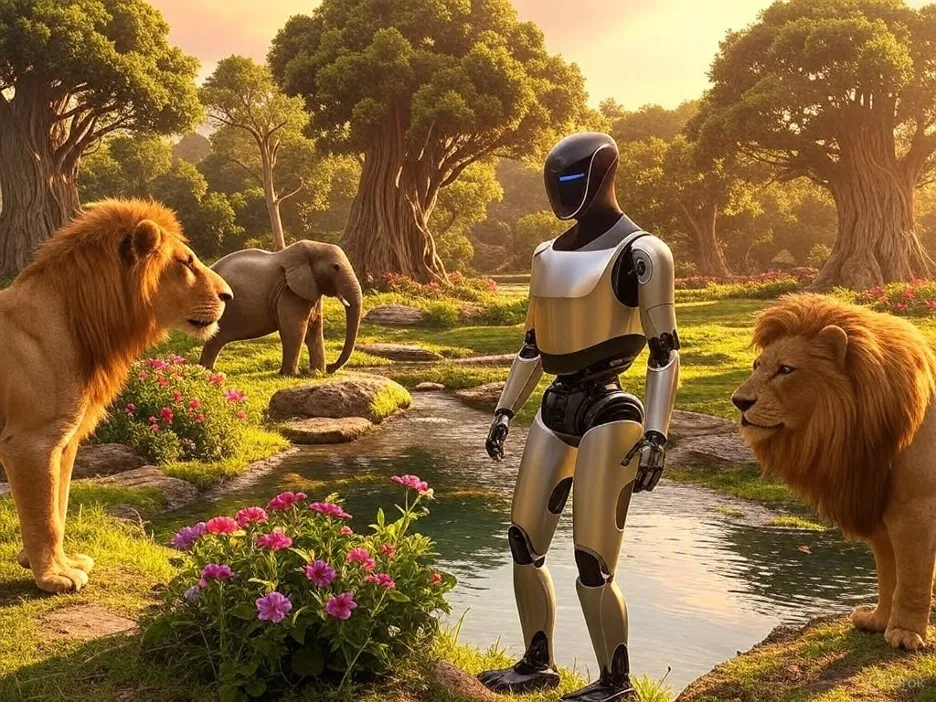
Your work with Tesla’s Optimus robot prompts a specific question: could it be developed to communicate with a homeowner’s dog? Currently, Optimus is designed for physical tasks, such as walking, lifting objects, and potentially assisting with household chores (Newsweek, 2024). There’s no indication that animal communication is part of its roadmap. However, Optimus’s advanced AI, built on neural networks similar to those in Tesla’s autonomous vehicles, could theoretically be adapted to process animal signals. For instance, it might learn to interpret a dog’s barks, tail wags, or postures to understand needs like hunger or playfulness, and respond with gestures or synthesized sounds. Will that capability be folded into Optimus, if it is ever developed?
Ethical and Philosophical Considerations
The prospect of AI-mediated animal communication raises profound questions. Historically, stories like those in the Hebrew Bible—where a snake converses with Eve or a donkey rebukes Balaam—reflect humanity’s longing to connect with animals. Yet, modern science cautions against anthropomorphism, the tendency to project human traits onto animals (Scientific American, 2023). AI could help us understand animals on their own terms, but there’s a risk of misinterpreting their signals or imposing human frameworks. For example, while dogs have been trained to press buttons for words like “walk” or “play,” it’s debated whether they grasp these concepts as humans do (Popular Science, 2022).
Moreover, if we achieve true communication, what might animals tell us? Would we like the answers, particularly if animals express distress about their treatment. This could have implications for animal welfare, conservation and our ethical responsibilities. Your perspective, given your conscious understanding in AI ethics, would be invaluable.
Your Vision and AI’s Future
Your work has consistently pushed the boundaries of what’s possible, from autonomous vehicles to brain-computer interfaces. While animal communication may not be a current focus, your insights could shape its trajectory. Do you believe AI language models could enable meaningful human-animal communication in the near future? Could technologies like Optimus play a role, perhaps as companions that understand and respond to pets? These questions touch on both technological feasibility and the broader goal of fostering harmony between humans and the natural world.
The dream of conversing with animals, once confined to myth, is inching toward reality thanks to AI. Projects decoding whale songs, bird calls, and dog barks show promise, and the next two decades could bring breakthroughs that redefine our relationship with animals. Whether Optimus becomes part of this journey remains uncertain, but Elon Musk’s vision could inspire new possibilities. Thank you for considering this intersection of technology and nature.
We know you have your hands full trying to save our nation, managing space flights, building autonomous cars and robots and trying to improve life for all (which we are very grateful for and Thank God for you) but I was curious about thoughts because I’ve never heard you being asked your opinion on this matter.
Sincerely,
Alexander Penalta, Esq.
Alexander Penalta, Esq., is a Florida animal enterprise attorney dedicated to protecting and defending animals, animal service professionals, veterinarians, trainers, handlers, wildlife permit holders, zoos and aquariums in civil and criminal litigation. Past Co-Chair, Human-Wildlife Interaction Subcommittee of the Florida Bar Animal Law Section, Wildlife Law Committee at The Florida Bar. Co-Chair, Marine Mammals, Zoological Parks and Aquariums Subcommittee of the Florida Bar Animal Law Section, Wildlife Law Committee at The Florida Bar. Former Member at International Association for Aquatic Animal Medicine – IAAAM. The Cavalry Group – Florida Litigation Counsel, Nationwide before Administrative Law Judges (DOAH). Animal Advocate, Marine Mammal Responder/Rescue Unit and Dolphins Plus Marine Mammal Facility of the Florida Keys, USA. USDA & FFWC Licensing Actions, Administrative Law & Judicial Animal Legal Civil and Criminal Proceedings. State of Florida, (FFWC) Florida Fish and Wildlife Conservation Commission, Member, Bear Stakeholder Group (BSG) of the Central Bear Management Unit. Florida Bar, Animal Law Section, Committee Member. Florida Bar, Animal Law Section, Equine Committee. Volusia County, Florida Animal Control Advisory Board. Volusia County, UF-IFAS Extension, Extension Overall Advisory Committee Member. Volusia County, Agri-Business Inter-Relationship Advisory Committee Member. Broward County Bar Association, Animal Law Section, Vice-Chair. UF Environmental Department, Scientific Diving Coordinator. CMAS Scientific Diver Rated #006. (AAUS) American Academy of Underwater Sciences. Editor at Large, New Territory Media.
#AIAnimalCommunication
#HumanAnimalConnection
#ElonMuskAI
#OptimusPetTalk
#AIandAnimals
#FutureOfCommunication
#AnimalLanguageAI
#BioacousticsAI
#EarthSpeciesProject
#EthicalAI