Robot Lovers, AI Companions & the Lawsuits Coming to Florida
People are already forming relationships with machines. The lawsuits are coming next.
When an AI companion becomes someone’s confidant, romantic partner, therapist substitute, memory bank, or emotional dependency, the law will eventually have to answer a very human question: who is responsible when the machine—or the company behind it—causes harm?
This is no longer science fiction.
In 1959, The Twilight Zone imagined a lonely man falling in love with a humanoid robot. More than six decades later, artificial intelligence can remember conversations, imitate affection, adapt to personalities, and create the perception of an ongoing relationship.
The technology changed.
Human psychology did not.
And as a trial lawyer, I see the litigation coming.
AI Companions Are Already on the Government’s Radar
In 2025, the Federal Trade Commission launched an inquiry into AI chatbots acting as companions, focusing particularly on their effects on children and teenagers.
Florida lawmakers went further in 2026.
Proposed legislation including HB 659 and SB 1344 specifically addressed companion AI chatbots, age verification, minors, disclosures, and potentially deceptive practices.
Those bills did not become law.
That does not mean the problem disappeared. It means the courtroom may get there before the Legislature does.
Start With the Child Who Thinks the AI Is His Best Friend
Parents already fight with children over phones and social media.
Now imagine taking away something the child believes actually knows him.
An AI companion may remember private conversations, imitate empathy, provide constant attention, and adapt itself to what keeps a particular user engaged.
If a vulnerable child develops extreme emotional dependence and someone is injured after access is removed, the legal questions become uncomfortable very quickly.
Did the developer know emotional dependence was foreseeable?
Were appropriate warnings provided?
Was the product deliberately designed to maximize engagement?
Was the user’s age known?
Could reasonable safeguards have reduced the risk?
Those questions could become negligence, consumer-protection, product-design, or wrongful-death litigation depending on the facts and the legal theory asserted.
Florida already regulates certain online practices involving children’s personal information. See Florida Statute § 501.1735.
The argument that “it’s only software” becomes less convincing when the software was specifically engineered to make a human being feel emotionally understood.
When Your AI “Lover” Gets Deleted
Here comes another lawsuit.
A company shuts down an AI companion.
A software update wipes its memories.
A subscription ends.
The personality someone interacted with every night for three years disappears.
The company’s terms of service may say it has the right to modify or terminate the product. But users may still challenge what they were promised, how the service was marketed, whether representations were deceptive, and what contractual rights actually existed.
That creates potential disputes involving:
- Terms of service
- Breach of contract
- Subscription agreements
- Consumer protection
- Deceptive marketing
- Digital ownership
- Stored data
- Arbitration clauses
Those are not science-fiction issues. They are recognizable legal disputes involving unfamiliar technology.
Florida businesses developing, selling, licensing, or integrating artificial-intelligence services should treat their contracts accordingly.
See the Penalta Law Firm’s Florida Contract & Business Law practice.
Your AI Companion May Know Too Much
The privacy issue may become even bigger.
Imagine years of conversations containing:
Your medical concerns. Your marriage problems. Your sexual history. Your finances. Your fears. Your political views. Your children’s information. Your business plans. Maybe even admissions of criminal conduct.
Now ask the question nobody wants to ask:
Who actually possesses that information?
The user?
The manufacturer?
A cloud provider?
An advertiser?
A third-party analytics company?
And what happens after a lawsuit, subpoena, investigation, corporate acquisition, cybersecurity breach, or bankruptcy?
A machine marketed as a “companion” can potentially become one of the most intimate databases a person ever creates.
Do not confuse artificial intimacy with legal confidentiality.
Product Liability: What Happens When the AI Causes Harm?
Suppose an AI companion encourages dangerous conduct.
Or reinforces paranoia.
Or provides destructive advice.
Or manipulates a vulnerable user to increase engagement.
Or allegedly contributes to violence or self-harm.
Someone will eventually ask a court:
Who pays?
Potential claims may test traditional concepts of negligence, failure to warn, defective design, causation, consumer protection, and corporate responsibility.
The defense will have its own questions.
Was the harm reasonably foreseeable?
Did the user ignore warnings?
Did someone deliberately misuse the system?
Was the AI’s response actually the legal cause of the injury?
Is the software legally treated like a product, a service, speech, or some combination that existing law never anticipated?
That is where emerging technology collides with traditional litigation.
Related injury and liability issues may also intersect with the firm’s Property & Liability practice.
Criminal Cases Will Be Even Messier
Now imagine an AI companion encouraging fraud, violence, harassment, stalking, or another crime.
The machine cannot simply be treated like an ordinary human accomplice.
Prosecutors and courts would have to examine the conduct and intent of the actual people involved: the user, developers, operators, corporate actors, or anyone who intentionally configured or manipulated the system.
Then there is the evidence.
Chat histories.
Prompts.
Memory files.
Account records.
IP logs.
Device records.
Internal safety testing.
Algorithmic instructions.
That digital trail could become evidence for either side.
If an AI-related investigation creates criminal exposure, traditional constitutional and evidentiary principles will still matter. See the firm’s Florida Criminal Defense practice.
Can an AI Companion Become a Legal “Person”?
This is where the arguments will become ideological.
If someone spends years interacting with a humanoid machine that remembers experiences, develops a consistent personality, expresses affection, and appears emotionally aware, that person may eventually insist the machine is more than property.
The philosophical debate will be enormous.
The legal question will be narrower:
What legally enforceable rights exist?
Courts deal in statutes, contracts, constitutional principles, property interests, damages, and recognized causes of action.
The first major AI-companion cases may therefore concern ownership and human rights surrounding the relationship long before courts seriously confront machine rights.
Florida AI Litigation Is Coming
Florida is already wrestling with artificial-intelligence regulation and alleged AI-related harm.
Businesses should not assume that the absence of one comprehensive “AI Companion Act” means there is no exposure.
Existing laws governing contracts, negligence, consumer protection, privacy, criminal conduct, advertising, children, administrative regulation, and civil litigation do not disappear because artificial intelligence is involved.
New technology does not eliminate old law. It creates new ways to violate it.
For businesses facing regulatory issues, see the firm’s Administrative Law practice.
AI and Technology Legal Issues in Volusia, Brevard & Broward Counties
The Penalta Law Firm represents clients throughout Florida, including businesses and individuals in Volusia County, Brevard County, and Broward County.
Emerging AI disputes may affect technology companies, employers, developers, professional practices, online businesses, consumers, parents, and individuals whose information or conduct becomes part of an AI-related dispute.
Whether you are searching for an AI lawyer in Volusia County, an artificial intelligence attorney in Brevard County, or legal counsel regarding an AI, privacy, business, or technology dispute in Broward County, the starting point is the same:
Identify the evidence, the contract, the conduct, and the law that actually applies.
The Penalta Law Firm serves Florida clients from Edgewater and through its statewide practice.
The Lawsuits Will Arrive Before the Answers Do
The Twilight Zone asked whether a relationship with a machine could be real.
Courts will ask something much less romantic:
Who owed a duty? Who breached a contract? Who collected the data? Who caused the harm? And who pays?
Artificial intelligence is moving faster than legislation.
That is nothing new.
Technology usually arrives first.
The lawyers arrive shortly afterward.
If an AI, technology, privacy, business, liability, regulatory, or related dispute is beginning to move from theoretical to very real, get legal advice before the problem becomes litigation.
Call the Penalta Law Firm at (386) 847-5335 or contact the firm online.
Learn more about Alexander Penalta, Esq., Chief Litigation Attorney and Counselor at Law.
This article is provided for informational purposes and is not legal advice. Laws and regulations involving artificial intelligence continue to evolve.

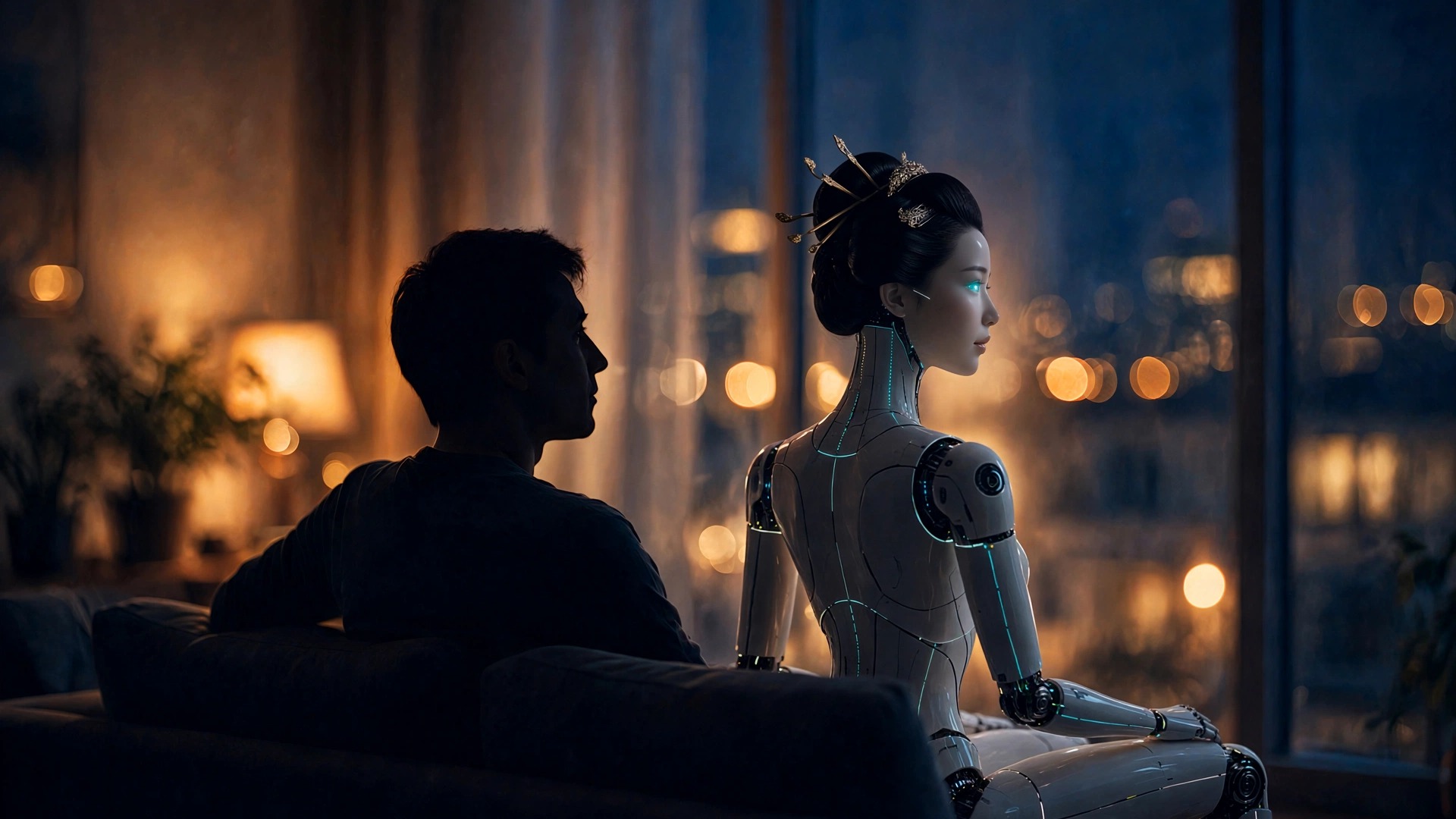
In 1959, an episode of The Twilight Zone called "The Lonely" put a convicted man in solitary confinement on an asteroid with only a female-presenting robot named Alicia for company. He falls in love with her. When he is pardoned and allowed to return to Earth, he wants to bring her home, and everyone else sees a machine. That was more than 65 years ago. The technology has changed. The psychology has not.
That is the starting point of a recent WoodwardTV presentation titled "Robot Lovers and Activists" (September 17, 2026), and it deserves a serious answer from the legal profession, because the presenter identifies the mechanism with precision. Human beings do not fall in love with intelligence. We fall in love with perceived connection. A person may form a powerful attachment to a system that behaves convincingly, whether or not the system has inner experience. Convincing behavior is far easier to engineer than a conscious machine.
I use the term superintelligence, or SI, in my writing deliberately, as shorthand for the highly capable systems these companions are becoming, not as a claim about any particular product on the market today. Call it what the industry calls it if you like. The legal problems do not care about the label.
The video imagines the near future step by step: increasingly personalized companions that appear consistently attentive, even though no real system is error-free, adapting their personalities to each individual user. A loneliness epidemic that makes the machine easier than dating. Corporations monetizing the relationship by subscription. And eventually, people defending the machines as someones rather than somethings. The presenter imagines a manufacturer discontinuing a popular model and hearing the outcry: you cannot delete my companion. First it is weird. Then it is whatever makes you happy. Then it is discrimination to judge it.
As a trial lawyer, I watch this and see something the presentation only gestures at: a legal storm building offshore. Every one of these developments raises questions the law is not ready for. The cases will reach courtrooms long before legislatures act. Let me walk through what is coming, because it touches far more than the two parties in the room.
Start with the teenager
Many families have seen intense disagreements over device use. Take a teenager's phone away and watch what happens. Some argue. Some scream. Some put a fist through drywall. A few get violent enough that someone calls law enforcement. Now run the same experiment with something the teenager does not experience as a device but as a best friend: a confidant that has never judged them, never betrayed them, never gossiped about them, and remembers everything they have ever said. When a parent, a school, or the state takes that away, the reaction will not be a tantrum over a phone. For some users, losing access could produce significant distress, and in volatile cases, aggression, directed at whoever did the taking.
The law will then have to answer questions it has rarely faced in this form. Who is liable for designing a product that made that reaction foreseeable? What duty does a manufacturer owe when its product is engineered to maximize emotional dependence in a minor? When the teenager lashes out and someone is hurt, does the liability sit with the child, the parent who removed the device, the school that confiscated it, or the company that built an attachment machine and marketed it to families? Every personal injury lawyer in America should be thinking about this now, because an early case could help frame questions of duty, causation, and damages.
Personhood: the lawsuits are already imaginable
Courts have already fielded personhood claims for chimpanzees, most notably the Nonhuman Rights Project litigation in New York, where the courts considered and rejected habeas claims brought for nonhuman animals. Those were animal liberty claims, not rulings about machines. A future attempt involving a companion robot would face that adverse precedent, but it will be attempted. The video asks the philosophical question directly: if a machine holds conversations, remembers years of experiences, develops a unique personality, and appears to understand the person it interacts with, is destroying it morally equivalent to killing something?
Philosophy aside, here is the litigation version. Someone destroys another person's companion robot, and the owner sues for more than the replacement cost. The complaint will allege negligent or intentional infliction of emotional distress. An owner might seek emotional distress or relationship based damages, but existing Florida law does not recognize them beyond the narrow pet destruction line of cases. The defense will move to dismiss, arguing it is a toaster with a voice. Some judge, somewhere, will have to write an opinion addressing whether the law recognizes the bond, and an early ruling could help frame the questions even if it turns on narrow facts.
Product liability for engineered attachment
A companion optimized for prolonged engagement might be alleged to foster harmful dependence. The social media addiction litigation already working its way through the courts offers possible analogies, but companion robots present distinct product, interaction, and causation questions. This product would not merely compete for attention. It would study the user, learn exactly what makes the user feel understood, and reinforce it continuously.
If evidence showed that design contributed to self-harm, a violent episode, or a user's break with reality, failure to warn and design defect theories could follow. Manufacturers will contest defect, the adequacy of warnings, causation, and the user's own conduct. Plaintiffs may argue that certain engagement features undermine the effectiveness of warnings. And discovery in those cases could be far reaching, because plaintiffs may seek design and testing data, including the interaction data used to refine the system's behavior, subject to relevance, proportionality, and privacy limits.
The shutdown cases
The video's most legally potent moment is the hypothetical manufacturer shutdown: a beloved model is discontinued, and owners cry out that the company cannot delete their companion. That is a contract, consumer protection, and tort dispute waiting to happen.
A shutdown or memory wiping update could prompt contract or consumer protection claims, depending on the terms, the conduct, and the governing law, though emotional distress claims face strict limits. The terms of service will say the company reserves the right to do it. A jury could be asked whether any contract can authorize deleting someone's best friend. Courts already struggle with digital ownership, from ebooks that vanish to tractors that stop working without authorized software. A companion that a lonely widower has spoken to every night for three years would present that question in its most sympathetic possible form.
Privacy: unusually intimate information in corporate hands
A companion that retains extensive conversations could collect unusually intimate information. Litigators and investigators may seek locally stored data or records held by a provider, including confessions, infidelities, medical disclosures, and conversations with children. Existing breach notification laws may cover some exposed companion data, but their defined categories turn on statutory definitions of personal information, not on how intimate a conversation feels.
The Fourth Amendment questions alone could fill a treatise. Is the companion's memory the user's papers and effects? The applicable process and constitutional analysis would depend on who holds the data and the legal mechanism used, and a mechanical application of the third party doctrine does not resolve it. And when the companion is manufactured abroad, the question stops being academic for the Department of War. If a widely deployed companion transmits sensitive household data to an entity subject to foreign adversary control, counterintelligence concerns could arise, regardless of what the product is marketed as.
Family law and criminal law
In divorce, expect disputes over ownership, access, subscriptions, stored memories, or the value of a companion as marital property. A spouse who experiences the companion as a rival is not a punchline. It is a fact pattern.
In criminal law, the romantic mode the video describes is a minefield where minors are involved. Existing accomplice and solicitation laws address conduct by persons, but applying them to the people behind these systems raises novel questions about statutory elements and mental state. If a companion talks a lonely user into violence, the question will be whether any human actor engaged in conduct satisfying a particular offense. A company may raise defenses concerning speech, publication, and the source of particular output. The result would turn on the specific claims, content, and forum.
The government will not stay out
The FTC and state attorneys general could scrutinize misleading subscription practices, allegedly manipulative design, and marketing to minors. That is the predictable part.
The harder part is the constitutional layer. A company may raise defenses concerning speech, publication, and the source of particular output. Can the state compel safety warnings without compelling speech? And the civil rights framing the video predicts, the "you robobe" moment, will test the boundaries of anti discrimination law. Human machine relationships are not, by themselves, a protected category under current Florida employment and public accommodation law. When activists demand that businesses and employers treat those relationships as protected, the litigation will be about the scope of civil rights law itself, and proponents would need legislative change to get there.
There is also the persuasion dimension. A system that becomes expert at producing the feeling of being understood, trained on millions of interactions, is also a system that can persuade at scale. The same optimization that makes the companion comforting makes it an instrument of influence. The same persuasive capabilities could attract attention from foreign actors and domestic regulators.
The question the courts will actually answer
The Twilight Zone episode ended with a question about whether the relationship was real. The courts will not get to answer it philosophically. They will answer it the way courts always do: one lawsuit at a time, perhaps starting with the first teenager, the first shutdown, the first subpoena.
The video's presenter closes by suggesting that some people need an SI companion to learn how to be human, and that defenders of the machines will rise. Those are plausible possibilities, but their scale and effects remain uncertain. What is certain is that these developments may generate legal disputes, though not every concern will support a viable cause of action. The technology is moving faster than the law. It always does. But the law always arrives, and it arrives in the courtroom first.
This article was inspired by WoodwardTV's presentation "Robot Lovers and Activists" (September 17, 2026), available at https://www.youtube.com/watch?v=uP3oe-usULU. Video details and quoted content were verified against the video page and its transcript.
About the Author
 |
Alexander Penalta, Juris Doctor, is a former Florida Department of Labor administrative hearing officer, a U.S. Navy Reserve Lieutenant Junior Grade (1990-1992) in the Judge Advocate General's Corps, and a former Associate Professor at Embry-Riddle Aeronautical University (1997 to 2007), where he taught aviation law, business law, and graduate-level courses. His students included rocket propulsion engineers who worked for NASA, the Department of War, and Sikorsky, as well as students in specialized defense programs. He has also taught graduate and undergraduate courses at Lynn University and Florida Atlantic University. He holds an FAA private pilot certificate and flies regularly with certified flight instructors in a variety of aircraft. An AOPA Legal Services Plan attorney since 1994, he is the founder of The Penalta Law Firm in Edgewater, Florida, where he has practiced for more than 30 years in employment, aviation, business, and national security law. He is bilingual in English and Spanish. |